
Governance
Our Board of Governors comprises highly experienced specialists with extensive knowledge across various sectors, providing strategic guidance and comprehensive oversight for our organisation’s success.
Our Leadership

Peter James Francis
Chair of the Board of Governors, Independent Governor
Peter Francis is the Chair of the Board of William College. He has a record of achievement in leadership and management in HE as an academic and senior executive.
Throughout his career, Peter has promoted excellent student and staff experiences, high quality student outcomes and effective knowledge exchange by enabling participation, engagement, collaboration, interdisciplinarity, innovation, quality and standards in learning, teaching, enterprise and applied research. Recently he led a collaborative multi-organisation R&D project promoting mental health data analytics, funded by the OfS’s Mental Health Challenge Competition.
As a criminologist, Peter’s work has had impact. He has led research, evaluation, knowledge exchange and consultancy projects and teams, supervised to completion a wide range of doctoral studies, and co-authored student textbooks, alongside edited collections and referred articles. His last co-edited textbook was published by Sage Publishing in 2025.
Peter is currently an Associate of the Cormack Consultancy Group, and a Non-Executive for educational organisations.

Peter James Francis
Chair of the Board of Governors, Independent Governor

Dr Joanna Voulgaroupoulou
Independent Governor

Dr Giles Proctor
Independent Governor

Asaduzzaman Lotus
CEO, Executive Governor

Nick Hillman
Provost, Executive Governor
Executive Leadership Team

Lotus Asaduzzaman
CEO
With over a decade of experience in UK higher education, Asaduzzaman brings strong expertise in leadership and operational standards that support high-quality education, alongside a commitment to widening participation and improving access for diverse student communities; his academic background provides a multidisciplinary perspective that blends technical knowledge with strategic leadership to drive institutional excellence and student experience.

Lotus Asaduzzaman
CEO

Nick Hillman
Provost

Ramin Nassajpour
Head of Professional Services
Senior Leadership Team

Ramin Nassajpour
Head of Professional Services

Nick Hillman
Provost

Ramin Nassajpour
Head of Professional Services

Janet Martin
Governance Manager

Edward Saling
Academic Partnerships Development Manager

Linda Asquith
Academic Dean (Leeds)

Kayleigh O’Sullivan
Student Experience Manager (Stratford)

Matt Tamplin
Student Experience Manager (Leeds)

Marina Estato Apsan Frediani
Academic Manager (Stratford)

Raihan Ferdous
Campus Operations Manager (Stratford)

Will Johns
Campus Operations Manager (Leeds)

Annastasia Jane Gatsoulis
Assistant HR Manager
VISION, MISSION AND VALUES
Vision
To transform lives by widening access to higher education centred on law and connected disciplines.
Mission
To empower students from all backgrounds through high quality, career focused programmes shaped by student voice, and supported by excellent teaching, well-being services and tailored career guidance.
Values
Respect
We value every individual in our diverse college, fostering a culture of inclusion and mutual respect.
Integrity
We act with honesty and responsibility, upholding the highest standards in all we do.
Innovation
We embrace research informed, forward thinking approaches in our teaching, learning and professional practice.
Belonging
We nurture a strong sense of community and connection amongst students, staff, and partners.
COPORATE GOVERNANCE
1. Levels of Entrenchment
William College's Articles of Association contain entrenched provisions, given formal effect through a Notice of Entrenchment filed under section 22 of the Companies Act 2006. These provisions sit above ordinary articles in the governance hierarchy and require additional safeguards before they can be amended or repealed. They fall into three categories:
Category A – Statutory Entrenchments.
The most heavily protected provisions, entrenched under section 22 of the Companies Act 2006. Article 4.7 (the College's objects and powers) can only be amended with approval from a majority of Independent Governors plus a special resolution of the Company's Members. Article 5.6 (the Governing Body and education-reserved matters, covering Articles 5.1–5.6) requires either unanimous or 75% majority approval of Independent Governors, a special resolution of Members, and prior written notice to the Office for Students.
Category B – Functional or Conditional Entrenchments.
Protected through conditional or dual-key approval mechanisms rather than statutory entrenchment. This includes Article 5.7.3 (amendments to the Management and Governance Framework require Board approval and Academic Board ratification), Article 5.8.4 (loss of an Independent Governor majority automatically suspends approval of distributions and structural changes), and Article 5.8.5 (the Chair of any Governors' meeting or committee cannot be a Shareholder).
Category C – Protective Governance Entrenchments.
Provisions reinforcing the College's independent governance ethos: Article 5.9.3 (fiduciary duty of Governors), Article 5.9.4 (fit and proper persons), and Article 6.4 (solvency and compliance affirmation for distributions).
Collectively, these entrenchments impose conditions on change that go beyond standard Companies Act requirements, protecting the College's educational mission, academic independence, and regulatory standing.
2. Management and Governance Framework — Introduction
The Management and Governance Framework translates that constitutional basis into the principles, structures, delegations, and procedures that enable effective leadership, oversight, and assurance. It draws on the Committee of University Chairs (CUC) Higher Education Code of Governance, the Public Interest Governance Principles, and the Office for Students (OfS) regulatory framework, with financial sustainability, academic standards, student experience, EDI, and environmental sustainability as cross-cutting priorities.
Governing documents sit in a clear hierarchy:
-
Articles of Association.
-
Management & Governance Framework.
-
Scheme of Delegation.
-
Committee Terms of Reference.
-
Board-owned codes and policies.
-
the Risk Management Framework.
-
Institutional KPIs.
-
Academic Regulations documents.
Where documents conflict, the higher-order document prevails, with the Secretary to the Board responsible for resolving any inconsistency within 30 days.
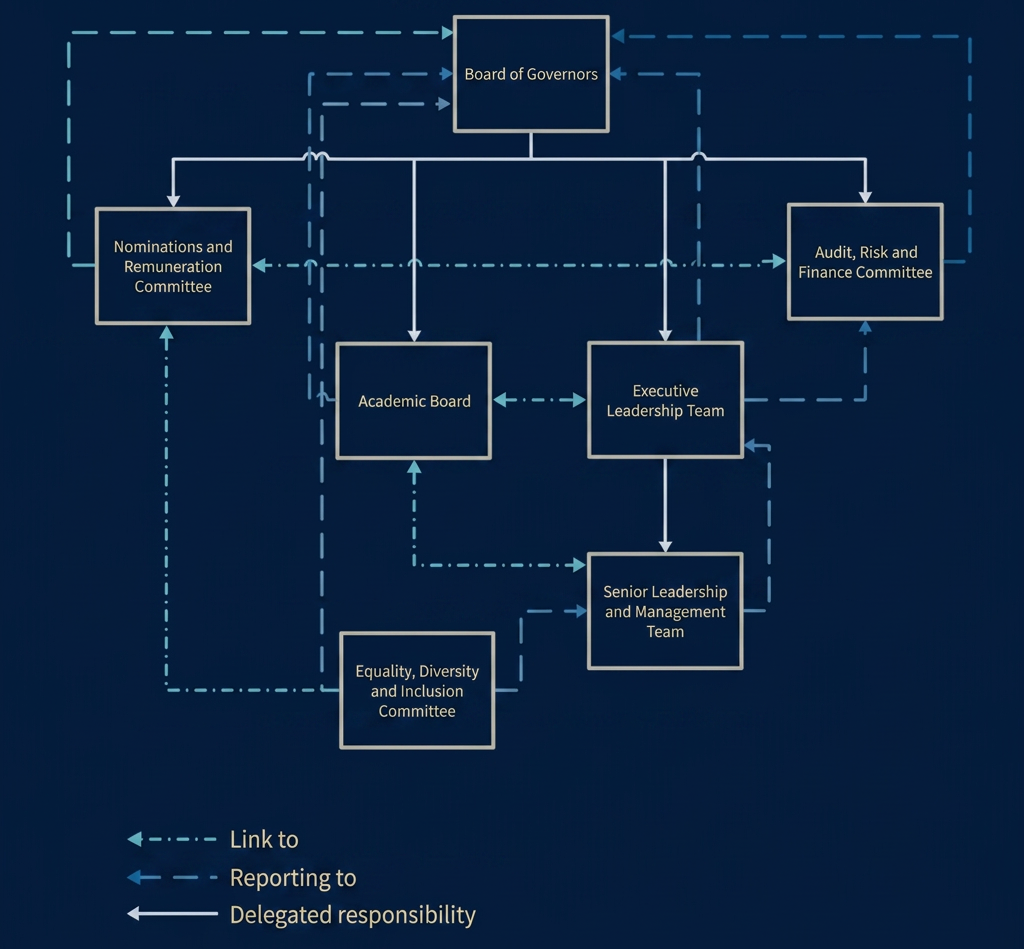
The Board of Governors holds ultimate responsibility for governance and oversight, delegating specific functions to its sub-committees and executive committees while retaining overall accountability.
3. Scheme of Delegation
The Scheme of Delegation sets out how the Board of Governors exercises and delegates its authority, recording who has authority to make which decisions and at what level. It operates alongside the Articles of Association and is read in conjunction with the Management and Governance Framework, Committee Terms of Reference, and Financial Regulations. The Board retains ultimate accountability for all delegated functions, may recall any delegated authority at any time, and no decision may be artificially divided to circumvent the authority levels set out in the Scheme.
Two-Tier Governance Structure
William College operates a two-tier governance structure. The Board of Directors holds ultimate legal and corporate responsibility under the Companies Act 2006, retaining residual powers not expressly delegated to the Board of Governors — including oversight of financial and operational matters outside Education-Reserved Matters, ensuring solvency, and approving asset restructuring and capital investment within parameters set by the Board of Governors.
The Board of Governors is the Governing Body for OfS regulatory purposes and holds supreme decision-making authority over all Education-Reserved Matters, with decisions in that sphere binding on the Board of Directors.
Dual-Key Matters
Certain decisions require approval from both Boards: capital expenditure above set thresholds; entry into or withdrawal from academic validation, franchise, or collaborative partnership arrangements; declaration of special dividends or distributions above agreed limits; and major structural changes that could materially affect programme delivery, student continuation, or institutional sustainability.
Reserved Matters
The following cannot be delegated and remain with the full Board of Governors:
-
Institutional mission, vision, values, and strategic plan.
-
Five-year business plan and annual budget.
-
Audited financial statements and Annual Value for Money Statement.
-
Appointment and removal of Governors, including the Chair and Deputy Chair.
-
Appointment and removal of the CEO/Accountable Officer.
-
This Scheme of Delegation and any amendments to it.
-
Terms of Reference for all sub-committees.
-
Key governance policies: Conflicts of Interest; Fit and Proper Persons; Anti-Fraud and Public Funds; Risk Management Framework.
-
Formal response to OfS reportable events.
-
Annual Board effectiveness self-assessment.
4. Committees
Board of Governors
Ultimate governance authority with an Independent Governor majority, chaired by an Independent Governor. Sets strategic direction, approves the budget and business plan, oversees regulatory compliance, appoints the CEO, and retains final accountability for all delegated functions. Meets at least four times a year.
Nominations and Remuneration Committee (NRC)
Independent Governor-majority, chaired by an Independent Governor. Recommends Board appointments, leads "fit and proper persons" due diligence, and sets senior staff remuneration policy. Meets at least twice yearly.
Audit, Risk and Finance Committee (ARFC)
Minimum 3 Independent Governors with relevant finance/audit/risk expertise. Oversees internal/external audit, financial reporting and controls, the institutional risk register, and ethical/behavioural standards (whistleblowing, fraud, conflicts of interest). Meets four times a year.
Academic Board (AcBo)
Chaired by the Provost, 10–15 members including academic and student representatives. Accountable for OfS Conditions A, B, C, E and F: access and participation, quality and standards, student protection, academic governance, and provision of information. Meets four times a year.
Executive Leadership Team (ELT)
CEO, Provost, Head of Professional Services, with the Governance Manager in attendance. Provides strategic leadership, owns the strategic risk register, and oversees institutional strategy, performance, and people/resources. Meets fortnightly.
Senior Leadership and Management Team (SLMT)
Chaired by the Head of Professional Services, comprising academic and professional services leaders across campuses. Responsible for day-to-day operational delivery, the operational risk register, and regulatory compliance at an operational level. Meets fortnightly.
Equality, Diversity and Inclusion (EDI) Committee
Chaired by the Academic Partnerships Development Manager, with staff and student representation across campuses. Drives EDI strategy, policy, and outcomes, and provides a forum for staff/student feedback on EDI matters. Meets at least four times a year.
William College’s Strategy (2025-2030)
Objective 1
To optimise entry and participation in higher education for learners who demonstrate the potential to succeed.
Objective 2
To deliver a compelling educational experience through support, and nurture a sense of belonging.
Objective 3
To uphold academic quality and standards and deliver successful outcomes.
Objective 4
To deliver successful employability and graduate outcomes for our students.
Objective 5
To maintain accountability and sustainability through robust and transparent governance.
Objective 6
To strengthen and embed a culture of collegiality, support and success across the College.
Objective 7
To grow alongside and together with our valued partners.
How Strategy, Risk and KPIs Connect
The Strategic Framework, the Institutional Risk Register, and the Institutional KPI Framework operate as a single, interconnected assurance cycle rather than three separate documents.
Each objective above is broken down into specific goals and actions with named accountable owners (CEO, Provost, Head of Professional Services).
The KPI Framework translates each Strategic Objective into measurable performance indicators, mapped directly back to the objective it supports, with defined ELT ownership, SLMT responsibility, and reporting lines, alongside lead and lag indicators. This allows the Board and its committees to monitor, in quantifiable terms, whether the College is actually delivering against its strategic goals — rather than relying on narrative reporting alone.
The Risk Register captures the threats that could prevent those objectives and KPIs from being achieved. Each risk is scored for likelihood and impact, both before and after mitigation, assigned a named Risk Owner, and reviewed on a defined cycle. Where a risk relates to delivery of a strategic objective (e.g. financial sustainability, academic quality, student outcomes), it is explicitly linked back to that part of the Strategic Framework, ensuring risk management is focused on what matters most to institutional success rather than operating in isolation.
Together, this creates a closed loop: the Strategic Framework defines the destination, the KPI Framework measures progress towards it, and the Risk Register identifies and manages what could get in the way — all reporting up through the ELT, SLMT, ARFC, and ultimately the Board of Governors, in line with the Management and Governance Framework's delegation structure


